
 By
By 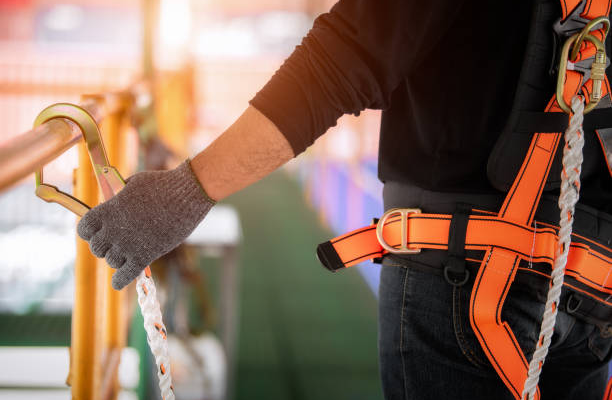
Every year, hundreds of Swedish construction workers are injured when they fall from a height – and most of the accidents could have been avoided. A fallskyddssele is not just a requirement in the binder, it is the only thing that actually keeps you in place if the ground suddenly disappears under your feet.
But what exactly is it? And more importantly: when are you required to wear one?
This is a fall protection harness – short and to the point
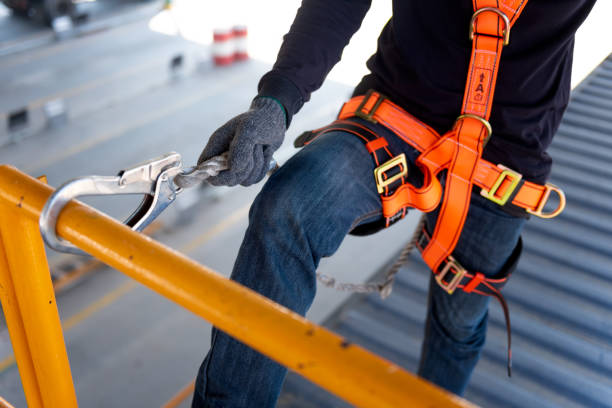
A fall protection harness is a body-worn safety equipment that is distributed around the chest, shoulders, hips and thighs. It is connected via a rope or a fall arrester to an anchor point – a beam, a rig, a rail system. If you slip or lose your footing, the harness absorbs the power and keeps you hanging, instead of hitting the ground.
It sounds simple. It is not.
A poorly fitted fall protection harness can cause serious internal injuries in the event of a fall, even if you never hit anything. The force that arises from a sudden stop – what we call jerk load – can damage the chest, shoulders and neck if the harness is incorrectly fitted. Buckles that are too loose or too high make the whole system ineffective. So it’s not enough to wear a harness – it has to fit correctly, every time.
When is it legal to use a fall protection harness?
The Swedish Work Environment Authority’s regulations (AFS 1999:3 and AFS 2020:1) are clear: fall protection is required when working where there is a risk of falling more than two metres. But it’s a floor, not a ceiling. Many industries and employers have stricter requirements of their own.
Specifically, fall protection harnesses apply above all to:
- Roof work – whether it’s a flat industrial roof or a gable roof on a house
- Scaffolding work – especially when working on façades without full guardrails
- Working in a lift or basket – many lift types require the operator to be on a leash at all times
- Work in masts, towers and wind turbines – here the harness is mandatory from the first step up
- Climbing and inspection of tall structures – bridges, silos, chimneys
One thing that surprises many: it is not enough to have the harness available on site. It must be on the body and connected for the entire time the risk exists. Taking off the harness to “just take a quick look” is precisely the behavior that costs lives.
Three types of selenium – and which one suits what
There is no one universal fall protection harness that fits every situation. It’s something I’ve seen go wrong in workplaces time and time again – people buy the cheapest option without thinking about the area of use.
- Full body harness (the most common)The classic variant with shoulder,chest and thigh straps. Suitable for most work on roofs and scaffolding. The connection point is usually located in the middle of the back, which provides a good hanging position in the event of a fall.
- Work positioning harnessUsed when you need to keep your hands free for a long time in a tilted position – for example, tree fellers, chimney sweeps or installers on towers. It has front anchors and support straps around the hip.
- Rescue and evacuation harnessUsed by rescue services and industries with the risk of personnel needing to be lifted out of confined spaces. Requires specific training.
Important: all harnesses must be CE marked according to EN 361 (fall protection) or EN 358 (work positioning). Check the label before you buy – not after.
How to check the harness correctly
Many people wear a fall protection harness daily without ever inspecting it. This is a mistake that could be fatal.
Before each use, follow these steps:
- Look at the fabric – cracks, abrasions, burnt marks or discolouration are reasons for stopping
- Test buckles and hooks – they should lock and unlock without resistance, but sit firmly under load
- Check seams – loose or rotten seams cause the harness to burst at the only time you really need it
- Check the manufacturer’s date – most harnesses have a lifespan of 10 years from manufacture, but a maximum of 5 years from first use
- If the harness has been in a fall – dispose of it immediately, no matter how whole it looks
The last point is crucial and is constantly underestimated. A harness that has held a fall has done its job – it is used up.
The anchor point determines whether everything works
A fall protection harness is only as good as the one it is connected to. It doesn’t help to have the world’s best harness if the anchorage gives way.
Anchor points must be able to receive at least 12 kN of static load, which corresponds to approximately 1,200 kg. They must be approved and excellent – spontaneous solutions such as water pipes, antennas or temporary hooks are never acceptable.
The lanyard, fall arrester and leash that connects the harness to the anchor point are just as important as the harness itself. They form a system, not just a collection of parts.
Education – what is often forgotten
It is not enough to buy the right equipment. Employers are required by law to ensure that employees are trained in using fall protection harnesses before working at height. That training should include:
- How to fit and put on the harness correctly
- How to select and control anchor points
- What to do if a fall occurs – rescuing a hanging person is critical, as a person hanging motionless in the harness can suffer from hanging syndrome within minutes
The latter is something many instructions skip. But it is not enough to “save” a colleague if the rescue takes 20 minutes – the damage can be permanent anyway.
The final word
A fall protection harness is mandatory for work with a fall risk of more than two metres, and in practice for most work on roofs, towers, scaffolding and lifts. But just wearing the harness is not enough – it must fit correctly, be connected to an approved point and be checked before each shift.













Comments